
Digital Proof of Delivery: Replacing Paper Challans with GPS, Weighment, and Timestamps
Photo: Bidgee, CC BY-SA 3.0 au, via Wikimedia Commons
Every truckload of coal, limestone, clinker, or fly ash ends with a piece of paper. The receiving site stamps or signs the delivery challan, the driver carries it back, and someone eventually hands it to accounts. Until that paper arrives, the transporter cannot bill, the supplier cannot invoice, and finance cannot close the trip. When the challan is lost, smudged, or disputed, payment stalls for everyone.
Why paper challans slow everything down
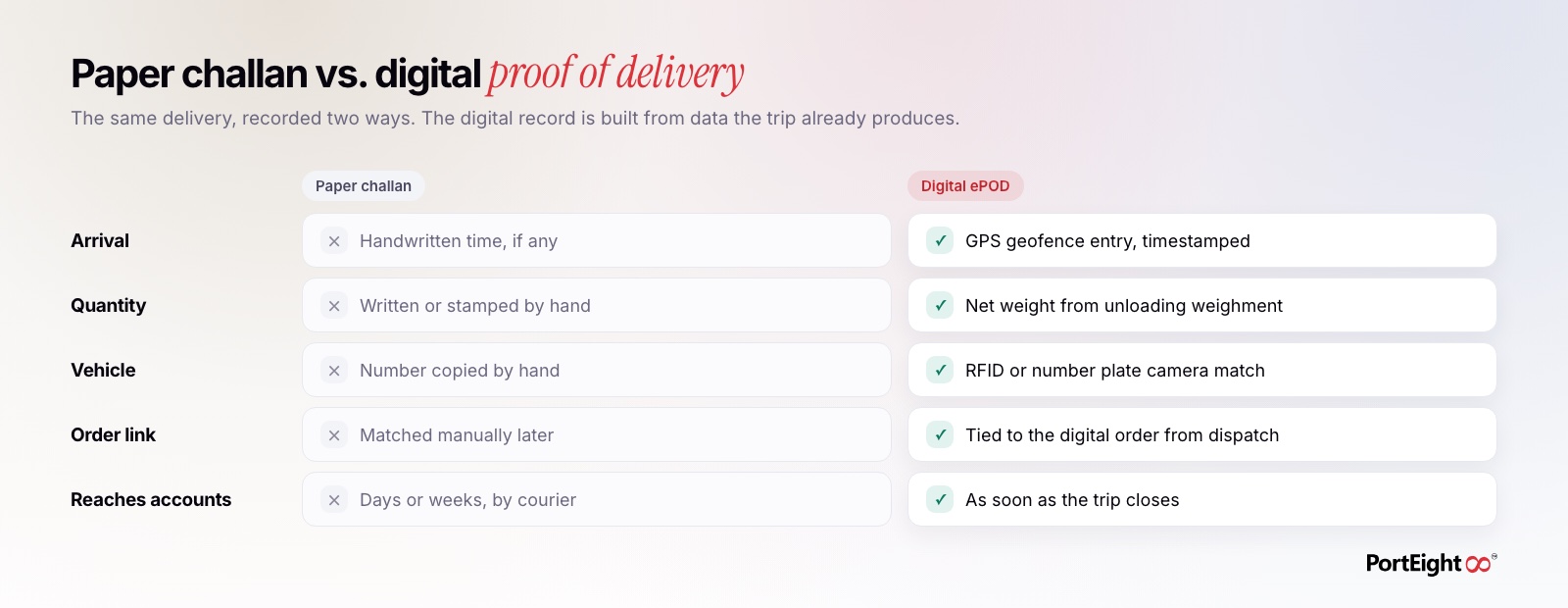
A paper challan is a single physical record that has to travel back through several hands before anyone can act on it. It records what someone wrote down, not what the trip data shows. That creates problems at every step.
- Delay: Challans reach accounts days or weeks after the delivery, often in batches, so billing and payment run late.
- Loss and damage: Paper is misplaced, torn, or soaked, and a missing challan can hold up a whole freight bill.
- Weak evidence: A stamp and a handwritten quantity are easy to question. If the supplier and receiver disagree, there is little to check against.
- Manual matching: Accounts teams match each challan to the order, the weighment slip, and the transporter bill by hand.
- No early warning: Nobody knows a delivery has a problem until the paper shows up.
What digital proof of delivery actually is
Digital proof of delivery, often called ePOD, is an electronic record that confirms a specific vehicle delivered a specific quantity to a specific site at a specific time, against a specific order. The key point is where the data comes from. A good ePOD is not a scanned photo of the paper challan. It is assembled from records the trip already produces: GPS position, weighbridge readings, and the digital order created at dispatch.
Because each piece comes from a system rather than a pen, the record is consistent, timestamped, and available the moment the trip ends.
The evidence that makes a delivery record trustworthy
A proof of delivery is only as strong as the evidence behind it. For bulk material, five pieces matter most. If any one is missing, the record becomes easier to dispute.
- Arrival at the right site: A geofence around the receiving plant or yard records when the truck entered and left. This shows the material went where the order said.
- Delivered quantity: The gross and tare weighments at the receiving weighbridge give the net weight actually delivered, not the quantity written at dispatch.
- Vehicle identity: RFID tags or camera-based number plate recognition at the weighbridge confirm which truck was weighed, so records cannot be swapped.
- Timestamps: Every event, from geofence entry to the final weighment, carries a system time. This shows the sequence and how long each step took.
- Order link: The trip is tied to its digital freight order from the start, so the delivery is automatically matched to the right material, supplier, and rate.
How an ePOD record is built, step by step
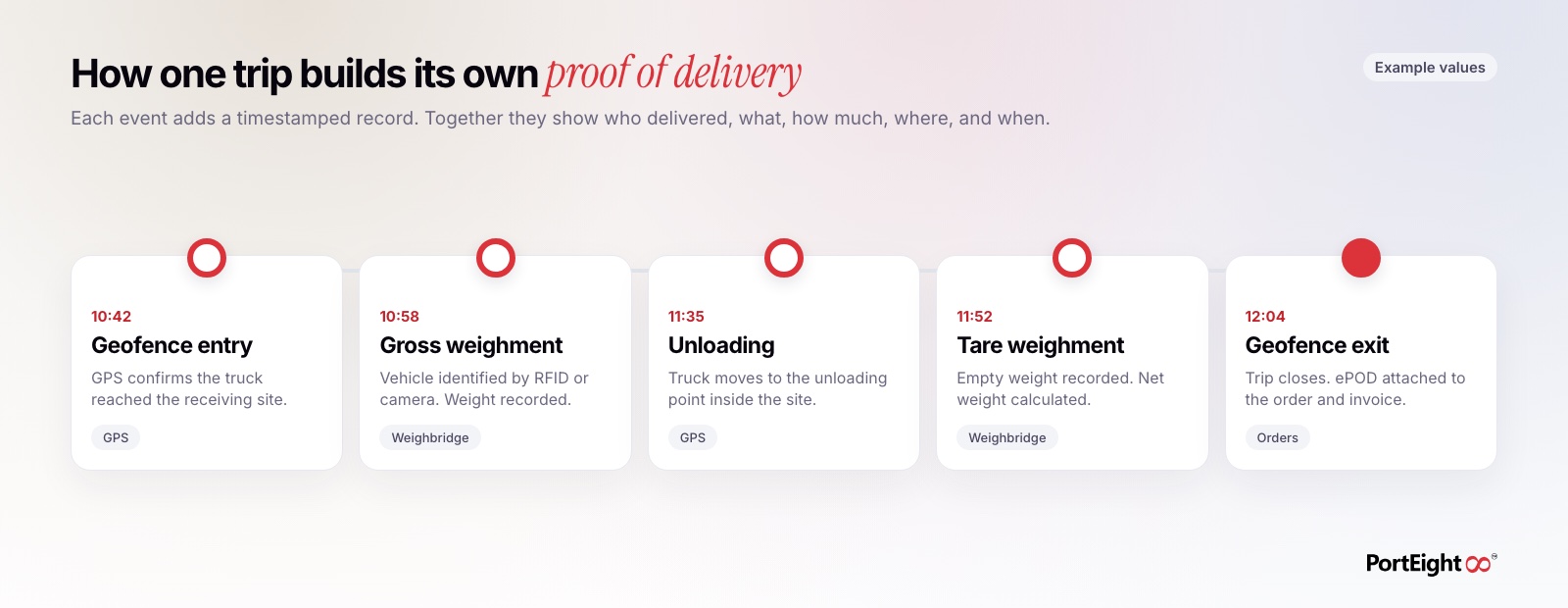
At a receiving site with GPS tracking and an automated weighbridge, the proof of delivery builds itself as the truck moves through the site. No one has to fill in a form.
- Dispatch: A digital freight order is created and the trip is linked to it, with the vehicle, material, and expected quantity.
- Geofence entry: GPS records the time the truck enters the receiving site boundary.
- Gross weighment: The weighbridge identifies the truck by RFID or camera and records the loaded weight.
- Unloading: The truck moves to the unloading point inside the site.
- Tare weighment: The empty truck is weighed again, and the net delivered weight is calculated.
- Geofence exit: The trip closes, and the complete record is attached to the order and made available for invoicing.
Handling exceptions without going back to paper
Most trips will close cleanly. The value of a digital record is that the ones that do not are flagged immediately, with the evidence attached, instead of surfacing weeks later.
- Short delivery: The net weight at the receiving weighbridge is compared with the dispatch weight. Trips outside the agreed tolerance are flagged for review.
- Wrong or unplanned site: If the truck never enters the receiving geofence, or stops for a long time somewhere else, the record shows it.
- Missing weighment: A trip with a geofence entry but no weighbridge record points to a process gap, such as a truck that bypassed the weighbridge.
- Vehicle mismatch: If the truck identified at the weighbridge is not the one assigned to the order, the trip is held until someone checks.
- GPS gaps: Tracking devices can lose signal in remote areas. Weighbridge records and timestamps still confirm the delivery, and the gap is noted on the trip.
Rolling it out without disrupting operations
Moving from paper to digital proof of delivery does not need to happen at every site at once. A phased approach keeps operations running and builds confidence in the data.
- Start with one route: Pick a high-volume route between one dispatch point and one receiving site.
- Set up geofences carefully: Draw boundaries that match the actual site gates, so entry and exit times are accurate.
- Automate the weighbridge first: Manual weight entry is the weakest link. Automated capture with vehicle identification removes most disputes.
- Run paper and digital side by side: For a few weeks, compare the digital record with the paper challan to find gaps in the setup.
- Agree on the record with transporters and suppliers: Make sure every party accepts the digital record as the basis for billing before you retire the paper.
- Retire the paper: Once the records match consistently and every party has agreed, switch billing to the digital record.
Once the switch is made, the gains show up on both sides. For logistics teams, a digital proof of delivery means knowing a trip is complete the moment it is complete, not when the paperwork catches up. For finance teams, it means invoices can be raised on the actual delivered quantity, matched automatically to the order, and backed by evidence that both sides can see. Disputes become shorter because the conversation starts from the same GPS, weighment, and timestamp records instead of two different pieces of paper.
How PortEight helps
PortEight builds the delivery record from the systems already running on your trips. GPS fleet tracking and geofencing record when each truck arrives at and leaves the receiving site. Manless weighbridge automation captures gross and tare weights directly, with RFID and camera-based number plate recognition to confirm the vehicle. Orders and payments handles digital freight orders, invoicing, and payments, so finance can bill against the weighed quantity and track payment status in the same place. The central dashboard brings it together, so operations and finance teams can see every completed delivery, and every exception, without waiting for a challan to come back.
Take control of your logistics
operations in real time
Automate tracking, optimize movement, and eliminate delays across your entire supply chain.
Contact Us