
Freight Rate Benchmarking for Bulk Transport: Using Trip Data to Price Every Lane
Photo: Sneha G Gupta, CC BY-SA 4.0, via Wikimedia Commons
Freight is one of the largest controllable costs for mining, cement, steel, and power companies, yet rates on many lanes are set the same way every year: take the old contract, add a revision, and compare a few fresh quotes. That process rarely asks whether the rate on one lane makes sense next to the rates on similar lanes, or next to what the trips on that lane actually look like. Freight rate benchmarking answers that question with data the plant already has.
Why freight rates drift without a benchmark
Rates rarely go wrong in one step. They drift. A lane gets an increase during a busy season and never comes back down. A new depot is priced from a quick quote. A transporter who was the only option on a route two years ago is still on the old terms even though others now serve it. Each decision looks reasonable on its own, but over time the rate card stops matching the work being done.
- Quotes reflect market conditions on the day they are taken, not the long-run cost of a lane.
- Contract revisions are often applied as a flat increase across all lanes, which locks in old gaps.
- Lanes with low volume get little attention, so their rates are rarely questioned.
- Finance teams see the total freight bill, but not which lanes are priced out of line.
Build the benchmark from trip records, not quotes
A useful benchmark starts from completed trips. Each trip already carries most of what you need: origin and destination, material, vehicle, transporter, loaded weight, distance traveled, and the freight billed. When these records come from GPS, weighbridge, and freight order systems rather than manual registers, they are consistent enough to compare across months and transporters.
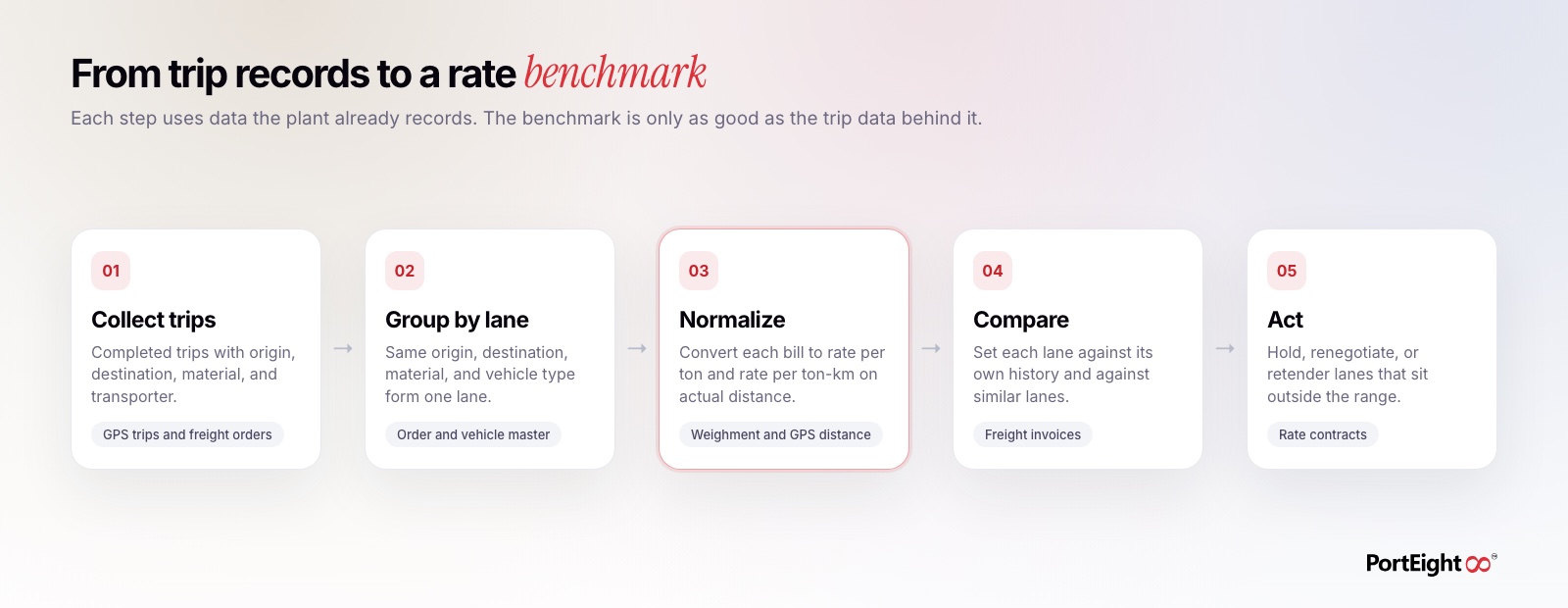
Quotes still have a place. They tell you where the market is moving. But a quote is a single number from one party. A benchmark built on hundreds of your own trips shows what you have actually been paying, and for what.
Define each lane carefully
Comparisons only work when like is compared with like. A lane should be defined tightly enough that the trips in it face similar conditions.
- Origin and destination: Use the actual loading and unloading points, such as a specific mine pit, siding, or depot, not just the city name.
- Material: Coal, limestone, clinker, cement bags, iron ore, and fly ash load and handle differently.
- Vehicle type: Tippers, trailers, bulkers, and container trucks carry different payloads and cost different amounts to run.
- Direction: An outbound lane with an assured return load is a different economic proposition from one where trucks return empty.
Normalize: rate per ton and rate per ton-km
Rates are quoted in different ways: per trip, per ton, or per ton per kilometer. To compare them, convert every bill to two common measures. Rate per ton divides the freight paid by the net weight delivered. Rate per ton-km divides the rate per ton by the distance traveled. Use the distance recorded by GPS for the actual route, not the distance written in the contract, which may be years old.
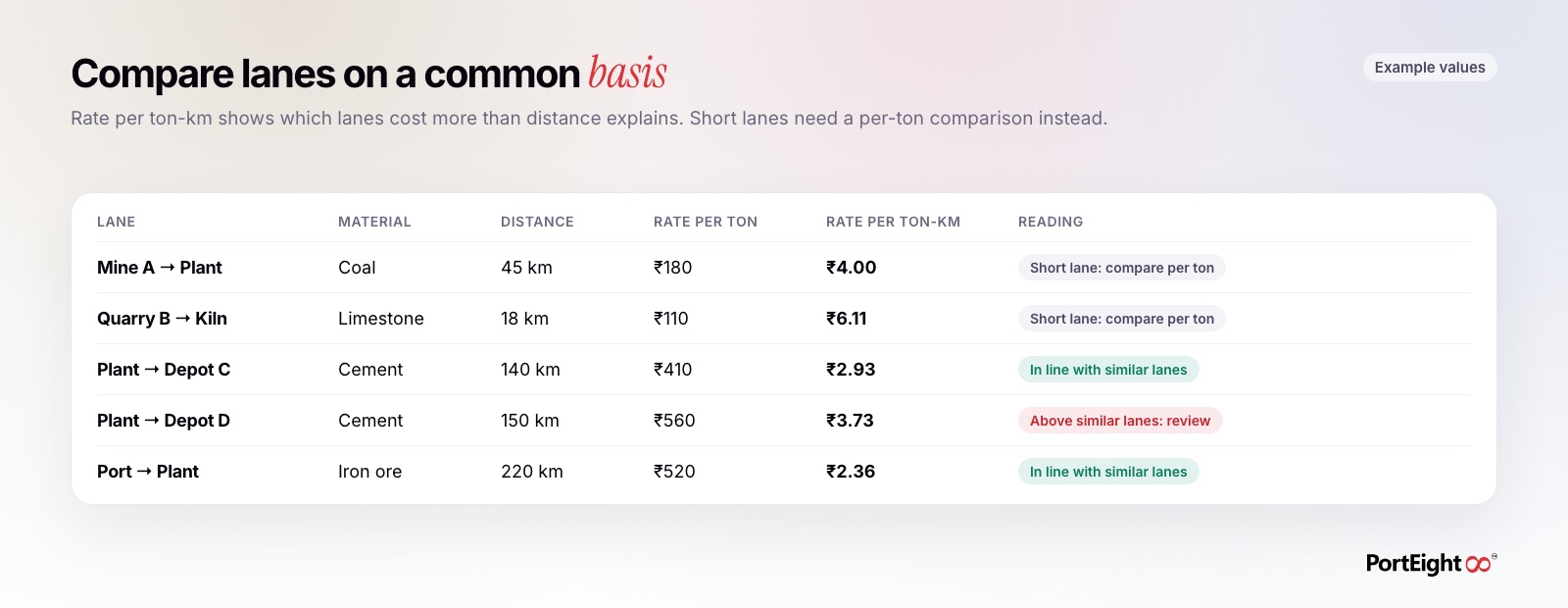
Rate per ton-km falls as distance rises, because loading, unloading, and waiting time are fixed costs spread over more kilometers. Short lanes, such as quarry to kiln, will always look expensive per ton-km. Compare those on rate per ton against other short lanes instead.
Account for what makes lanes different
A lane that costs more than its peers is not automatically overpriced. Before you raise it with a transporter, check whether trip data explains the gap.
- Turnaround time: If trucks wait for hours at your gate or weighbridge, transporters price that time into the rate. GPS and weighment timestamps show how long trucks spend on site.
- Road conditions: Ghat sections, unpaved mine roads, and congested urban stretches slow trucks and wear them faster.
- Return loads: Lanes where trucks can pick up a return load usually support a lower rate than lanes where they come back empty.
- Load size: If trucks routinely run below their rated payload because of loading limits or material density, the rate per ton rises even when the trip rate is fair.
- Seasonality: Monsoon months and harvest season can change truck availability on some routes.
When the data shows a reason, the fix may sit inside the plant rather than in the rate. Cutting time at the gate, for example, can do more for a lane than a hard negotiation.
Bring the benchmark to the negotiation
A benchmark changes the tone of rate discussions. Instead of arguing over a single quote, procurement and the transporter can look at the same trip history.
- Share the lane definition, trip count, and the period covered, so both sides know what is being compared.
- Show rate per ton and rate per ton-km for the lane next to similar lanes, with the trip data that explains any difference.
- Separate what the transporter controls, such as turnaround on the road, from what the plant controls, such as waiting time on site.
- Agree on a review cycle, such as quarterly, so rates follow the data instead of drifting again.
- For lanes that stay out of range, consider retendering with the benchmark as the reference price.
Benchmarks also help finance. When every freight bill is linked to a trip, a weight, and a contracted rate, unusual bills stand out before payment rather than at month-end.
How PortEight helps
PortEight brings together the records a freight benchmark depends on. GPS fleet tracking and geofencing record the actual route, distance, and time spent at loading and unloading points. Manless weighbridge automation, with RFID and camera-based number plate recognition, records net weights for every trip without manual entry. Orders and payments links each trip to its digital freight order, rate, and invoice. The central dashboard puts these together, so logistics and finance teams can review rates by lane, see which lanes sit outside the range, and bring the same trip history to every rate discussion.
Take control of your logistics
operations in real time
Automate tracking, optimize movement, and eliminate delays across your entire supply chain.
Contact Us