
Transporter Performance Scorecards: How to Rate Transporters and Use the Results in Rate Negotiations
Photo: Nikhilb239, CC BY-SA 4.0, via Wikimedia Commons
Most mining, cement, steel, and power companies work with several transporters on the same routes. When rates come up for renewal, the discussion usually starts with the transporter's new quote and the plant's memory of the last few bad weeks. Neither side has a shared record of how the trips actually went. A transporter performance scorecard fixes that. It turns trip data you already collect into a small set of scores that both sides can check, and it gives procurement a fair basis for deciding who gets more volume, who keeps their rate, and who needs an improvement plan.
Why rate discussions need a scorecard
Freight rate is only part of what a transporter costs you. A cheaper transporter whose trucks arrive late, lose material in transit, or raise frequent billing disputes can cost more than a slightly more expensive one that runs cleanly. Without a scorecard, those hidden costs never reach the negotiating table.
- Late arrivals hold up loading plans and dispatch targets.
- Slow round trips mean fewer trips per truck and more trucks needed for the same volume.
- Transit loss outside tolerance means material written off or recovered only after a long argument.
- Billing disputes tie up the finance team and delay closing the month.
A scorecard puts all four on the same page as the rate, so the conversation is about total cost and reliability, not just the price per ton.
The four measures that matter
Keep the scorecard short. Four measures cover most of what plants care about, and each one can be calculated from system records rather than manual registers.
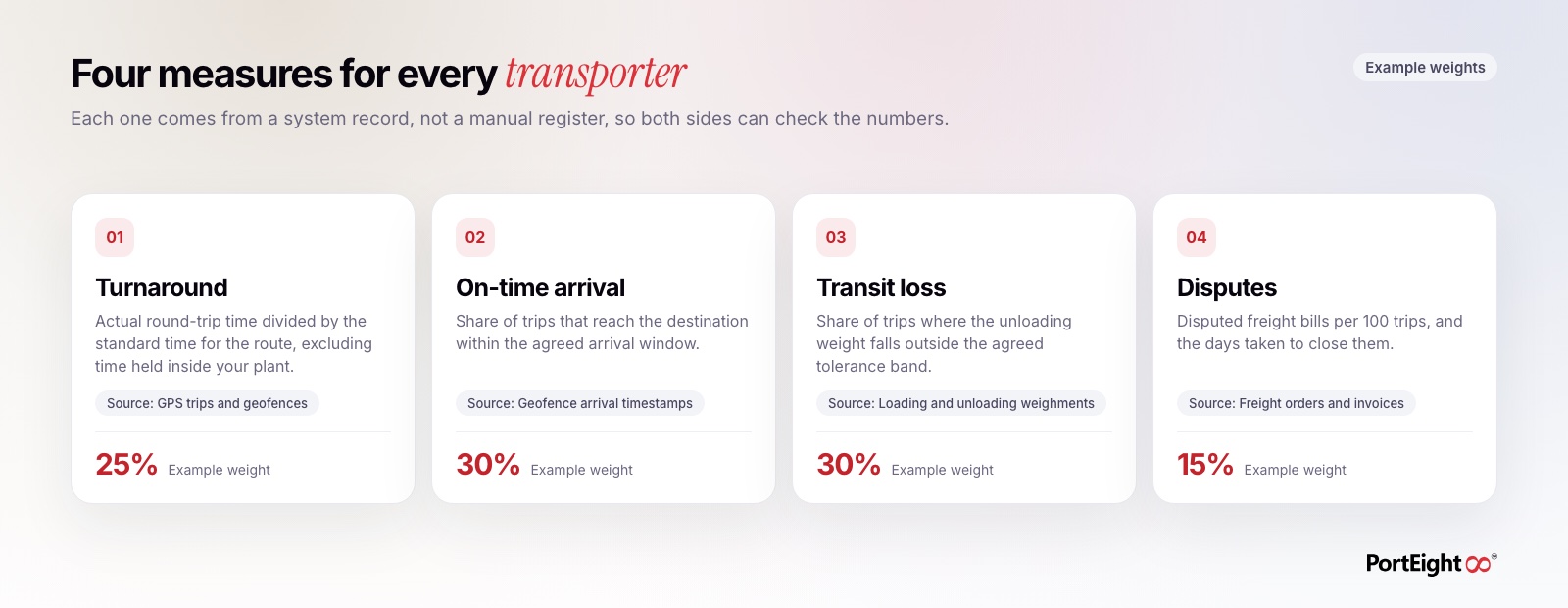
- Turnaround: Actual round-trip time compared with the standard time for the route. Exclude time the truck spent waiting inside your own plant, since the transporter does not control it.
- On-time arrival: The share of trips that reach the destination within the agreed arrival window.
- Transit loss: The share of trips where the unloading net weight falls outside the tolerance band in the contract.
- Disputes: Disputed freight bills per 100 trips, along with how many days they take to close.
Get the data right before you score anyone
A scorecard is only as fair as the data behind it. If transporters can show that the numbers are wrong, the scorecard loses its value in the first meeting. Before you publish scores, check that each measure comes from a record both sides can see.
- Use GPS geofence timestamps for departure, arrival at the destination, and return, instead of times written in a gate register.
- Record the time a truck spends inside your plant separately, so plant-side delays are not counted against the transporter.
- Weigh every truck at both ends, with fresh tare weights, and link both weighments to the same trip.
- Log every disputed freight bill against its trip, with the reason and the date it was closed.
- Agree on the route standard times and the arrival window with each transporter before the scoring period starts.
It also helps to set a minimum number of trips before a transporter is scored. A transporter with only a handful of trips in a month can look very good or very bad by chance.
Turn raw numbers into a single score
Each measure uses a different unit, so you need a simple way to put them on the same scale. A common approach is to set a target and a floor for each measure. A transporter at or better than the target scores 100. A transporter at or worse than the floor scores 0. Anything in between is scored on a straight line. Multiply each score by its weight and add them up to get a weighted score out of 100.
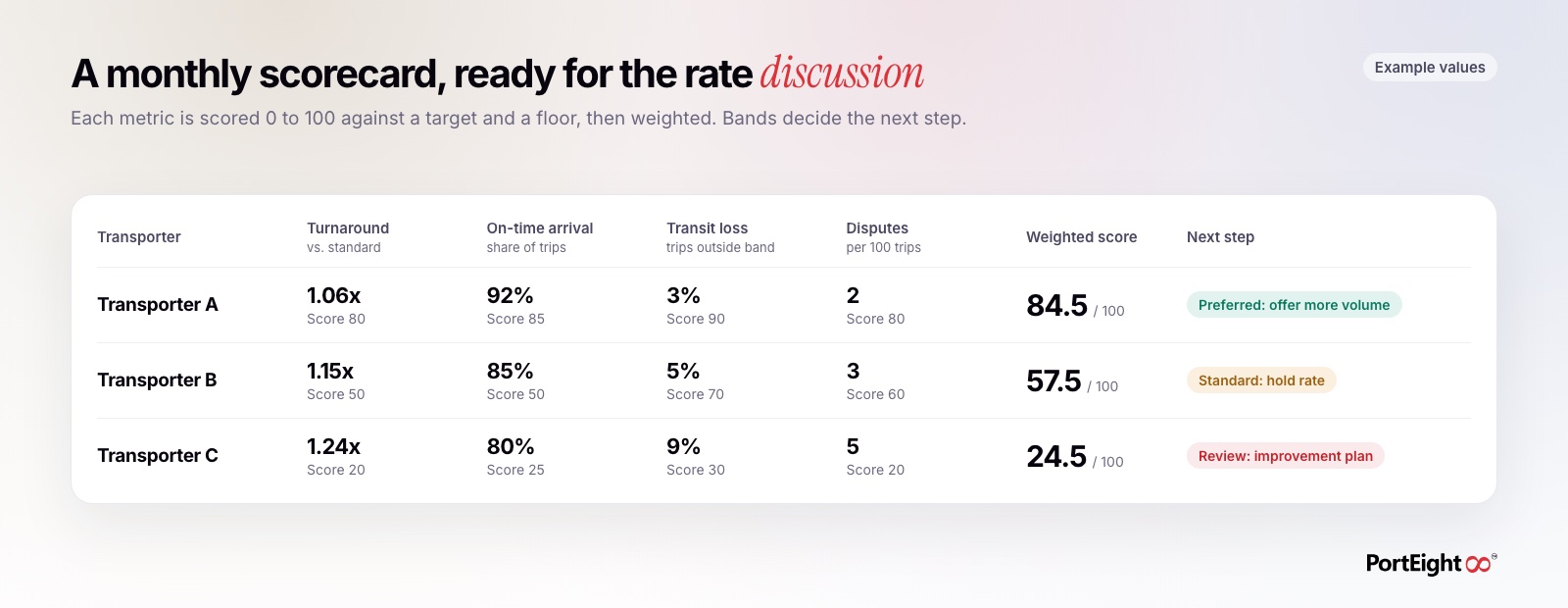
Then group transporters into bands. The bands matter more than the exact score, because they decide what happens next. Keep the targets, floors, weights, and bands the same for every transporter on a route, and change them only at the start of a new contract period.
Using the scorecard in rate negotiations
The scorecard does not set the rate by itself. It gives both sides a shared starting point and makes the trade-offs visible.
- Reward strong performers with volume: A transporter in the top band can be offered a larger share of trips on the route. Many transporters value steady volume as much as a higher rate.
- Compare quotes on total cost: Set a higher quote from a reliable transporter against the cost of delays, lost trips, and transit loss from a cheaper one.
- Link part of the rate to performance: Agree on a small incentive for staying in the top band, or a deduction for falling below the floor on a specific measure, and write it into the contract.
- Use trends, not single months: Bring three to six months of scores to the table so one unusual month does not drive the decision.
- Ask for a plan, not just a lower rate: For transporters in the review band, agree on specific fixes, such as fewer old vehicles on the route or better load covering, and a date to check progress.
Transporters also benefit. A good scorecard shows them where they are losing ground, and it protects them from blame for delays that happened inside your plant.
Run the review the same way every month
A scorecard works when it becomes routine. A short monthly review with each major transporter, using the same format every time, builds trust in the numbers.
- Share the scorecard with each transporter a few days before the meeting, along with the trip-level data behind it.
- Give transporters a set window to challenge specific trips, and correct the score if the challenge is valid.
- Record agreed actions and owners, and review them at the next meeting.
- Keep the full history, so contract renewals can draw on a year of scores rather than recent impressions.
How PortEight helps
PortEight brings the data a transporter scorecard needs into one place. GPS fleet tracking and geofencing record departure, arrival, and return times for every trip, and separate the time trucks spend inside your plant. Manless weighbridge automation, with RFID and camera-based number plate recognition, records weights against the same trip without manual entry, which gives you a reliable basis for transit loss checks. Orders and payments keeps digital freight orders and invoices tied to each trip, so a disputed bill can be checked against the trip record. The central dashboard brings this trip data together, so your logistics and procurement teams can walk into a rate discussion with numbers both sides can check.
Take control of your logistics
operations in real time
Automate tracking, optimize movement, and eliminate delays across your entire supply chain.
Contact Us